Best Wired Headphones for iPhone 17: USB-C Picks That Actually Sound Better Than AirPods
The shift to USB-C on the iPhone 17 finally opens up wired audio options that Lightning users spent years working around. No more MFi-only cables, no more dongles required for most modern earphones, and a much wider catalog to choose from — including audiophile models that previously needed adapters to work with an iPhone at all. The trade-off is that not every USB-C earphone is built equal: some include a built-in DAC, others rely on the phone’s audio path, and the quality gap between a $30 pair and a $250 pair is now genuinely audible on an iPhone.
Practical verdict: if you mostly take calls and stream Spotify or Apple Music, anything in the $30–60 USB-C bracket does the job better than the basic Apple dongle setup. If music quality matters and you want something that outperforms AirPods on detail and soundstage, the $150–250 range is where real upgrades start. Above $500, the gains are real but mostly relevant for listeners who’ll also use a dedicated DAC/amp later. Check whether your earphones include a built-in DAC or expect the phone to provide one — this decides whether you’ll need an extra adapter.
What Changed With iPhone 17 and Why Wired Still Matters
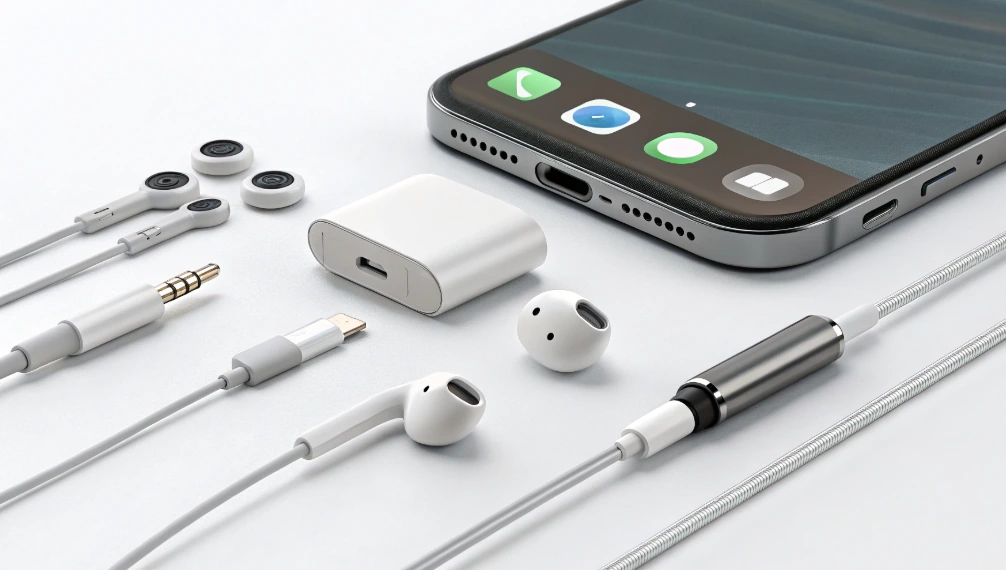
The iPhone 17 uses USB-C, which means almost any modern wired earphone with a USB-C plug works directly — no Lightning adapter, no MFi certification, no compatibility lottery. Earphones with a 3.5mm jack still need a USB-C-to-3.5mm adapter, but the iPhone supplies clean digital audio over USB-C, and good adapters now cost under $20.
Wired still wins on three concrete points compared to AirPods or other Bluetooth options: no battery to charge before a flight, no codec compression (lossless playback works end-to-end), and consistently lower latency, which matters for mobile gaming, video editing on the phone, and watching content where audio sync is noticeable. The sound-quality gap is the most underrated factor — a $50 wired pair routinely beats $150 Bluetooth earbuds on detail and timing, because there’s no compression in the chain.
The decision really comes down to budget and use case, not whether wired is “worth it.” All five picks below connect cleanly to the iPhone 17, and each targets a different listener.
Sony IER-EX15C — The Honest $30 Pick
Verdict in one line: the right answer when you need a working USB-C pair fast and don’t want to overthink it.
The Sony IER-EX15C ($29.99 as of 2026) plugs directly into the iPhone 17’s USB-C port, includes an in-line microphone with playback controls, and delivers the kind of clean, mid-focused sound Sony has built a reputation on at this price tier. Specs are modest: a 5mm driver, 20Hz–20kHz frequency response, 32Ω impedance, 108dB sensitivity, and a 1.2m cable.
Why it makes the list: the price-to-reliability ratio is hard to beat. For commuters, students, and anyone who loses earphones in a backpack twice a year, spending $30 on a pair that works without adapters is the rational choice.
Limitation: the 5mm driver doesn’t deliver deep sub-bass or wide soundstage. These are entry-level earphones — they sound good, not great.
Best for: casual listeners, replacement pairs for the gym bag, anyone who primarily uses earphones for podcasts and calls rather than music quality.
Practical detail worth knowing: the in-line mic picks up wind noise more than higher-end earphones. For outdoor calls in city environments, cup the mic with one hand when speaking.
Strauss & Wagner EM8C — The $50 Step Up With a Bigger Driver
Verdict in one line: noticeably more bass weight and presence than the Sony for under $20 more.
The Strauss & Wagner EM8C ($49.95) uses a 9mm driver — nearly twice the size of the Sony’s — and the difference is audible in low-end response and overall body. The frequency response runs the standard 20Hz–20kHz, with 32Ω impedance and 108dB sensitivity. Multiple silicone eartip sizes come in the box, which matters more than most people realize: the wrong tip size kills isolation and bass response on any IEM.
Why it makes the list: for $50, the EM8C deliver clean sound with punchy bass that doesn’t muddy the mids. The cable terminates directly to USB-C — no adapter — and the in-line microphone handles calls and Siri without issues.
Limitation: the tuning leans warm rather than analytical, so listeners who prefer flat or bright signatures will want to look further up the list.
Best for: budget-conscious buyers who listen to bass-forward genres (hip-hop, electronic, pop), iPhone 17 owners who replaced an AirPods pair and want similar convenience with better sound for less money.
Practical detail worth knowing: swap to the medium-large silicone tips if the included default feels loose — bass response on this pair depends heavily on seal, and many users underestimate which size actually fits them.
Meze Audio Alba — The First Real Audiophile Step at $159
Verdict in one line: the model where the upgrade over budget USB-C earphones becomes obvious in the first track.
The Meze Alba ($159) is where the catalog shifts from “good enough” to “actually impressive.” A 10.8mm dynamic driver, 15Hz–25kHz frequency response, 32Ω impedance, and 109dB sensitivity translate to wider bandwidth and noticeably more detail than anything in the sub-$100 range. The tuning is mildly V-shaped with strong vocal clarity, and the all-white aesthetic pairs well with Apple’s design language.
The Alba terminates to 3.5mm and ships with a 3.5mm-to-USB-C adapter in the box. That adapter includes a built-in DAC, so audio quality on the iPhone 17 is consistent and clean out of the box — no separate purchase needed.
Why it makes the list: at this price, the Alba brings genuine audiophile-brand tuning to iPhone 17 users without requiring extra gear. Vocal-heavy genres — singer-songwriter, pop, podcasts, audiobooks — gain real clarity over budget USB-C pairs.
Limitation: no microphone on the standard cable, which makes them inconvenient for frequent callers. The detachable cable can be swapped for one with a mic, but that’s a $30–50 add-on.
Best for: music-first listeners who already use a separate setup for calls, people moving up from AirPods who want to hear what they’ve been missing, listeners who prioritize vocal and instrumental clarity over bass impact.
Practical detail worth knowing: because the bundled adapter contains the DAC, the Alba sounds identical on iPhone, Android, and PC. If you swap between devices regularly, this is a real advantage over hardwired USB-C pairs.
Campfire Audio Axion — The $249 Mid-Tier With Mic and DAC Built In
Verdict in one line: the most versatile pick in this list, with audiophile-leaning sound plus working microphone and controls.
Campfire Audio is best known for IEMs that climb past $1,000, so the Axion ($249) is the brand’s accessible entry. It terminates directly to USB-C with a built-in DAC, includes an in-line microphone with playback and volume controls, and has a frequency response that extends down to 5Hz — meaningfully deeper than any of the cheaper options. Impedance is unusually low at 15.3Ω, which means the earphones drive easily from a phone without losing dynamics.
Why it makes the list: the Axion is the rare pair that does everything well — music, calls, gaming, video — on a USB-C phone, without compromises. For listeners who want one premium pair to handle every scenario, this is the cleanest pick on the list.
Limitation: the fixed USB-C cable means no swapping to balanced cables later, and no switching to other source devices that use different connectors without an adapter.
Best for: iPhone 17 users who want a single premium earphone for the phone and don’t plan to add a separate desktop chain, content creators who take calls and need clean playback in one tool, anyone tired of managing multiple pairs for different tasks.
Practical detail worth knowing: the in-line mic on the Axion picks up keyboard noise during voice calls more than typical headset mics. Mechanical keyboard users should mute when not actively speaking on calls.
Noble Audio XM-1 — The $599 Audiophile Endgame for USB-C
Verdict in one line: the technical ceiling of this list, but only worth the price if you’ll appreciate the detail it reveals.
The Noble Audio XM-1 ($599) is the most ambitious pair here. It uses a hybrid driver setup — one 8.3mm dynamic driver paired with an xMEMS solid-state tweeter — which delivers detail and high-frequency extension that conventional drivers struggle to match. Specs sit at 20Hz–20kHz frequency response, 32Ω impedance, and 101dB sensitivity, with a proprietary cable that terminates to USB-C with an integrated DAC.
Why it makes the list: the xMEMS driver is genuinely different technology, not a marketing label. Treble detail, transient response, and overall resolution are noticeably better than anything below $500 in this category.
Limitation: no microphone, no in-line controls, and the price only makes sense if you listen actively to music — for podcasts, calls, and background streaming, the gains over the Campfire Axion don’t justify the $350 jump.
Best for: serious audiophiles, music professionals who need accurate monitoring on a phone, listeners who already own quality headphones at home and want comparable performance for travel.
Practical detail worth knowing: xMEMS drivers respond well to clean source signal, so a future upgrade to a higher-tier portable DAC/amp will reveal more headroom than the same upgrade would on dynamic-driver-only earphones. The investment scales with the rest of the setup.
How to Choose Between Them
The five picks line up cleanly by budget and use case, and the table below makes the comparison fast:
| Model | Price | Connection | Mic | Best For |
| Sony IER-EX15C | $29.99 | USB-C | Yes | Casual listening, calls, replacement pair |
| Strauss & Wagner EM8C | $49.95 | USB-C | Yes | Bass-forward music, daily commute |
| Meze Audio Alba | $159 | 3.5mm + USB-C adapter (DAC) | No | Music-first listeners, vocal clarity |
| Campfire Audio Axion | $249 | USB-C (built-in DAC) | Yes | Versatile premium, all-day use |
| Noble Audio XM-1 | $599 | USB-C (built-in DAC) | No | Audiophiles, music professionals |
Before deciding, run through three checks. First, verify whether you need a microphone — the Alba and XM-1 don’t include one, which rules them out for users who take frequent calls. Second, confirm your listening priorities: if you mostly stream podcasts and YouTube, the $50 tier covers you fine, and the gains above that are music-specific. Third, think about whether a portable DAC/amp upgrade is in your future — if yes, the Alba (with its swappable adapter) and the Noble XM-1 (with proprietary cable that benefits from clean sources) scale better than fixed USB-C designs.
The bigger picture for iPhone 17 owners is that wired audio is finally a no-friction option again. Pick the price tier that matches how seriously you listen, confirm the microphone requirement against your call habits, and the rest follows.